
Home Health and Home Care Agency Insurance in California and Illinois: What You Need

By Ray Ramos, Founder
· 7 min read
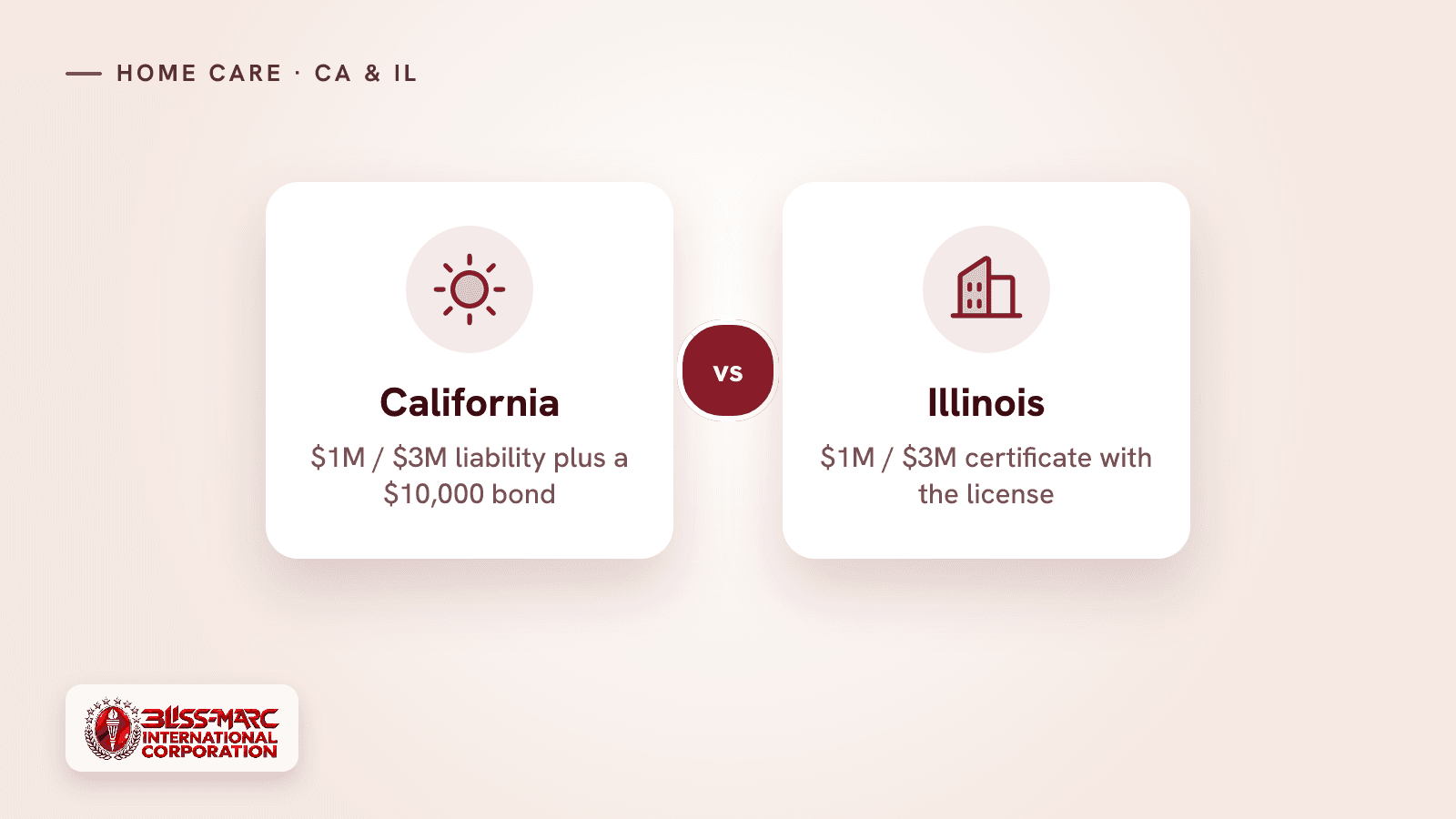
Short answer: both California and Illinois make insurance part of getting licensed. A California home care organization must show general and professional liability of at least $1 million per occurrence and $3 million aggregate, a workers' comp policy, and a $10,000 employee dishonesty bond. An Illinois home health, home nursing, or home services agency must submit a certificate showing $1 million per occurrence and $3 million aggregate in liability coverage with its license application, and Illinois law requires workers' comp as soon as you hire your first employee.
Home care has been a core specialty for Bliss Marc for decades. This guide covers what each state requires, what each policy actually protects, and the coverage gaps we see most often when agencies come to us.
Key takeaways
- California: Health and Safety Code section 1796.37 requires proof of general and professional liability ($1M per occurrence / $3M aggregate), workers' comp covering your home care aides, and a $10,000 employee dishonesty bond with third-party coverage.
- Illinois: 77 Ill. Adm. Code 245.90 requires a Certificate of Insurance showing $1M per occurrence / $3M aggregate liability for home health, home nursing, home services, and placement agency licenses.
- Workers' comp is usually the largest premium for a home care agency, and the class code you're assigned drives most of that cost.
- Caregivers driving their own cars to clients, abuse and molestation claims, and caregiver theft are three exposures a basic policy may not cover.
California requirements for home care organizations
California licenses non-medical home care through the Department of Social Services' Home Care Services Bureau. Under Health and Safety Code section 1796.37, an applicant for a home care organization (HCO) license must submit:
- Proof of general and professional liability insurance of at least $1,000,000 per occurrence and $3,000,000 in the aggregate.
- Proof of a valid workers' compensation policy covering affiliated home care aides, including the policy number, effective and expiration dates, and the carrier's name and address.
- Proof of an employee dishonesty bond, including third-party coverage, with a minimum limit of $10,000.
Home health agencies that provide skilled medical care are licensed separately through the California Department of Public Health. They need the same core coverages, often with higher professional liability limits because of the medical services involved.
Illinois requirements for home health and home services agencies
The Illinois Department of Public Health licenses home health, home nursing, home services, home nursing placement, and home services placement agencies under the Home Health, Home Services, and Home Nursing Agency Code. Section 245.90 states that a license application must be accompanied by a Certificate of Insurance documenting minimum liability coverage of $1 million per occurrence and $3 million in the aggregate.
Illinois also requires every employer with even one part-time employee to carry workers' compensation. An employer that knowingly goes without can be fined up to $500 for every day of noncompliance, with a $10,000 minimum, according to the Illinois Workers' Compensation Commission. Placement agencies should note that the rules also require client agreements to state who is responsible for workers' comp and liability coverage.
The coverages a home care agency needs
General liability
Covers bodily injury and property damage to third parties. A caregiver knocks over and breaks a client's heirloom lamp, or a visitor slips in your office. General liability does not cover injuries that result from the care itself. That's what professional liability is for.
Professional liability
Covers claims that your services caused harm: a missed medication reminder, a fall during a transfer, or a failure to follow the care plan. For home care, this is often the policy most likely to be tested by a lawsuit. Many carriers package general and professional liability together for healthcare agencies, which is how California's licensing requirement is written. See our guide to professional vs. general liability for the full breakdown.
Workers' compensation
Home care is physically demanding work. Lifting and transferring clients, driving between homes, and working in unfamiliar houses all lead to injuries. Workers' comp pays medical bills and lost wages and protects the agency from employee lawsuits over workplace injuries.
Class codes differ by state:
- California uses classification 8827 for both home care services (8827(1)) and nursing care in private residences (8827(2)). The WCIRB's approved advisory pure premium rate for both, effective September 1, 2026, is $2.794 per $100 of payroll.
- Illinois uses the NCCI system, where home health care workers are usually classified under code 8835.
- In both states, office staff who never visit clients can usually be reported under 8810 (clerical), which costs a small fraction of the caregiver rate. In California the 2026 advisory rate for 8810 is $0.214 per $100 of payroll.
Our article on what workers' comp costs in California and Illinois walks through a full premium example for a home care agency.
Employee dishonesty bond or crime coverage
Caregivers work alone in clients' homes, which creates theft risk. California requires a $10,000 dishonesty bond with third-party coverage, meaning it pays when an employee steals from a client, not only from your agency. We've written about why home health agencies are at risk for theft and fraud.
Hired and non-owned auto
If caregivers drive their own cars to clients or run errands for them, a serious accident can reach your agency even though you don't own the car. Personal auto policies may exclude business use. Hired and non-owned auto coverage fills that gap.
Abuse and molestation coverage
Many general and professional liability policies exclude or sharply limit abuse and molestation claims. For agencies serving elderly or disabled clients, check whether your policy covers these allegations. Defense costs alone can be substantial even when a claim is unfounded.
Common gaps we find in home care insurance programs
- Caregivers paid as 1099 contractors. If a worker is legally an employee, your workers' comp carrier can add that payroll at audit, and an uninsured injury can become your liability.
- Clerical staff reported in the caregiver class. This inflates premiums for no reason.
- Liability limits that don't meet licensing minimums after a renewal or carrier change.
- No non-owned auto coverage even though caregivers drive every day.
- A bond that covers only the agency's own losses, not theft from clients.
To build a program that meets these minimums, start with our home health and home care agency insurance page, or go straight to the California or Illinois requirements. Look up any caregiver or office class in our California class code search.
Get an instant estimate for your agency
Our online estimator was built for home health, home care, and hospice agencies. Enter your state and payroll to see an instant workers' comp range, or price liability coverage at $1 million per claim and $3 million aggregate, the same limits California and Illinois licensing requires. Like the number? Apply on the spot and a licensed Bliss Marc agent will call you.
Price your agency's coverage in two minutes →
Frequently asked questions
What insurance does a home care agency need in California?
To be licensed as a home care organization, California requires general and professional liability of at least $1 million per occurrence and $3 million aggregate, workers' compensation covering your home care aides, and an employee dishonesty bond of at least $10,000 with third-party coverage.
What insurance does a home services agency need in Illinois?
Illinois requires a Certificate of Insurance showing at least $1 million per occurrence and $3 million aggregate in liability coverage with the license application, and workers' compensation once you have any employees.
What is the workers' comp class code for home health care?
In California it's classification 8827 (home care services and nursing care in private residences). In Illinois and other NCCI states it's usually 8835. Office-only staff are typically 8810.
Do I need workers' comp if my caregivers are independent contractors?
Possibly. If your caregivers meet the legal definition of employees, they need to be covered regardless of how you pay them, and an insurer auditing your policy can add their payroll.
How much does home health agency insurance cost?
It depends mostly on caregiver payroll and claims history. Workers' comp is usually the largest piece. Our estimator gives you a range in about two minutes.
This article is general information, not legal advice. Licensing rules change, so confirm current requirements with the California Department of Social Services or the Illinois Department of Public Health. Bliss Marc International Corporation is a licensed insurance agency, California License #0H92044 and Illinois License #100299879.