
Professional Liability vs. General Liability Insurance: What's the Difference?

By Ray Ramos, Founder
· 6 min read
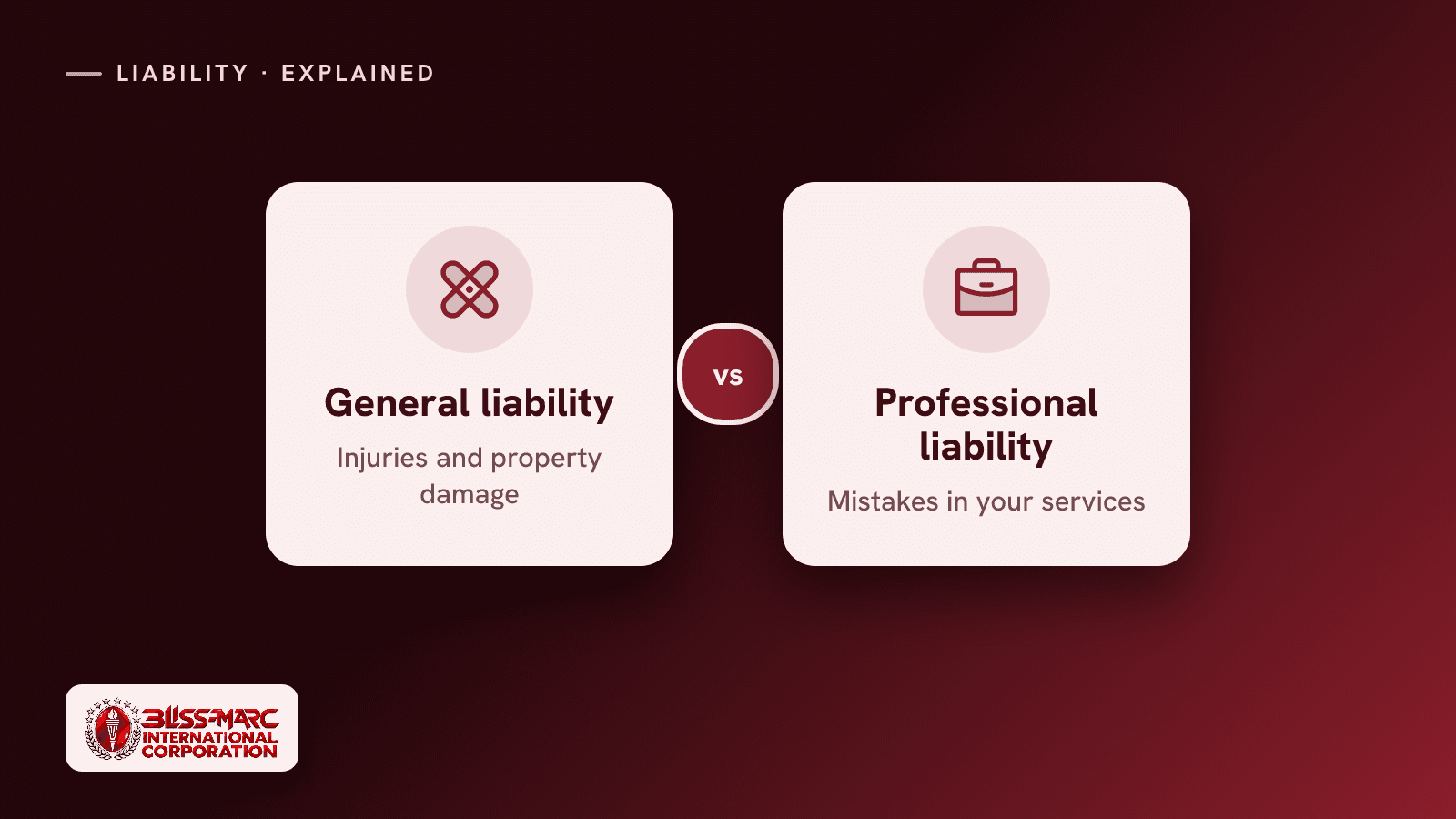
Short answer: general liability covers physical harm your business causes to other people, such as injuries and property damage. Professional liability, also called errors and omissions (E&O), covers financial or professional harm caused by your work, such as a mistake, missed deadline, bad advice, or failure to deliver the service you promised. They cover different risks, so most service businesses need both.
Business owners ask us this question more than almost any other. Here's a plain-English breakdown with real-world examples, including the industries where both policies are required by law.
Key takeaways
- General liability = bodily injury, property damage, and personal and advertising injury (like libel) to third parties.
- Professional liability / E&O = claims that your professional services, advice, or work product caused a client financial loss or harm.
- Each policy typically excludes what the other covers, so one does not replace the other.
- Some industries must carry both. California and Illinois both require home care agencies to show liability coverage of $1 million per occurrence and $3 million aggregate to get licensed.
Side-by-side comparison
| General liability | Professional liability (E&O) | |
|---|---|---|
| Covers | Bodily injury, property damage, personal and advertising injury | Negligence, errors, omissions, bad advice, failure to perform services |
| Typical claim | A client trips over a cord in your office and breaks a wrist | A client says your error cost them money and sues |
| Who usually needs it | Almost every business with customers, a location, or work on client premises | Anyone paid for expertise, advice, or professional services |
| Policy trigger | Usually occurrence: covers incidents during the policy period, whenever the claim is filed | Usually claims-made: covers claims filed while the policy is active, for work after a retroactive date |
| Who asks for it | Landlords, clients, and contracts | Clients, contracts, licensing boards, and regulators |
What general liability covers
Commercial general liability (CGL) protects you when your business operations injure someone or damage their property. It typically pays for legal defense, settlements, and judgments for:
- Bodily injury. A visitor slips on a wet floor at your office.
- Property damage. An employee damages a client's furniture while working in their home.
- Personal and advertising injury. Claims such as libel, slander, or using someone else's copyrighted image in an ad.
What it doesn't cover: injuries to your own employees (that's workers' compensation), damage to your own property, auto accidents, and claims arising from your professional services. That last exclusion is the reason professional liability exists.
What professional liability covers
Professional liability protects you when a client says your work fell short and it cost them. It typically pays defense costs and damages for claims of:
- Negligence or errors. An accountant miscalculates a client's estimated taxes and the client owes penalties.
- Omissions. A consultant forgets a key requirement in a project and the client loses a contract.
- Bad advice or misrepresentation. A client says your recommendation led to a financial loss.
- Failure to deliver. You miss a deadline and the client claims damages.
Even a claim with no merit can cost tens of thousands of dollars to defend. Defense costs are often the most valuable part of the policy. In healthcare, professional liability covers claims that care was delivered improperly, such as a fall during a client transfer or a medication error.
Why the trigger matters: occurrence vs. claims-made
Most general liability is written on an occurrence basis. If the incident happened while your policy was active, you're covered even if the lawsuit arrives years later.
Most professional liability is written on a claims-made basis. The claim must be made while a policy is active, for work performed after the policy's retroactive date. If you let the policy lapse or switch carriers without keeping your retroactive date, you can lose coverage for past work. When you retire or close the business, ask about "tail" coverage (an extended reporting period).
Real-world examples
Home care agency
A caregiver drops a client's tablet: general liability. A caregiver misses a scheduled medication reminder and the client is hospitalized: professional liability. California's licensing law for home care organizations requires proof of both general and professional liability, at least $1 million per occurrence and $3 million aggregate. Illinois requires $1 million / $3 million in liability coverage for home health and home services agency licenses. More in our home care agency insurance guide.
Consultant
A client trips over your laptop bag at their office: general liability. Your project recommendation leads the client to buy software that doesn't work for them, and they sue for the cost: professional liability.
Accountant or bookkeeper
A delivery driver slips on ice outside your office: general liability. You miss a payroll tax deposit deadline for a client and they're hit with penalties: professional liability.
Do you need both?
If you sell expertise or services, most likely yes. You need general liability for the physical risks that come with having clients, a location, or work in other people's spaces. You need professional liability because your biggest risk is usually a client saying your work cost them money. Contracts often require both, and in some industries, like licensed home care, the law does.
Many small businesses buy general liability inside a business owner's policy (BOP), which bundles it with property coverage, and add a separate professional liability policy. Healthcare agencies often buy a combined general and professional liability policy built for their industry.
What these policies cost
Price depends on your industry, revenue, number of employees, limits, deductible, and claims history. A small office-based consultant may pay relatively little for general liability, while professional liability for a healthcare agency or a firm handling client finances costs more because the potential claims are larger. The fastest way to see a real number is to price it.
For coverage built around your field, see professional liability for consultants, accountants and engineers, or our California professional liability page.
Our online estimator prices liability coverage at $1 million per claim and $3 million aggregate with a $2,500 deductible for home healthcare agencies, medical staffing, consulting, IT services, accounting and bookkeeping, real estate, marketing, engineering, and other professional services.
Get an instant liability estimate →
Learn more about our professional liability and general liability programs.
Frequently asked questions
Is professional liability the same as general liability?
No. General liability covers bodily injury and property damage to others. Professional liability covers financial harm caused by mistakes or failures in your professional services. Each typically excludes the other's risks.
Is errors and omissions insurance the same as professional liability?
Yes. Errors and omissions (E&O) is another name for professional liability insurance. In healthcare it's often called malpractice insurance.
Does general liability cover mistakes in my work?
Generally no. Standard general liability policies exclude claims arising from professional services. You need professional liability for that.
Can I get both in one policy?
Some industries can. Healthcare agencies, for example, often buy a combined general and professional liability policy. Other businesses typically pair a business owner's policy with a separate professional liability policy.
What limits should I carry?
$1 million per claim and $2 million to $3 million aggregate are common starting points, and some contracts and licenses set minimums. California and Illinois home care licensing both require $1 million per occurrence and $3 million aggregate.
This article is general information. Coverage depends on the specific policy language, so review your policy or talk with a licensed agent. Bliss Marc International Corporation is a licensed insurance agency, California License #0H92044 and Illinois License #100299879.